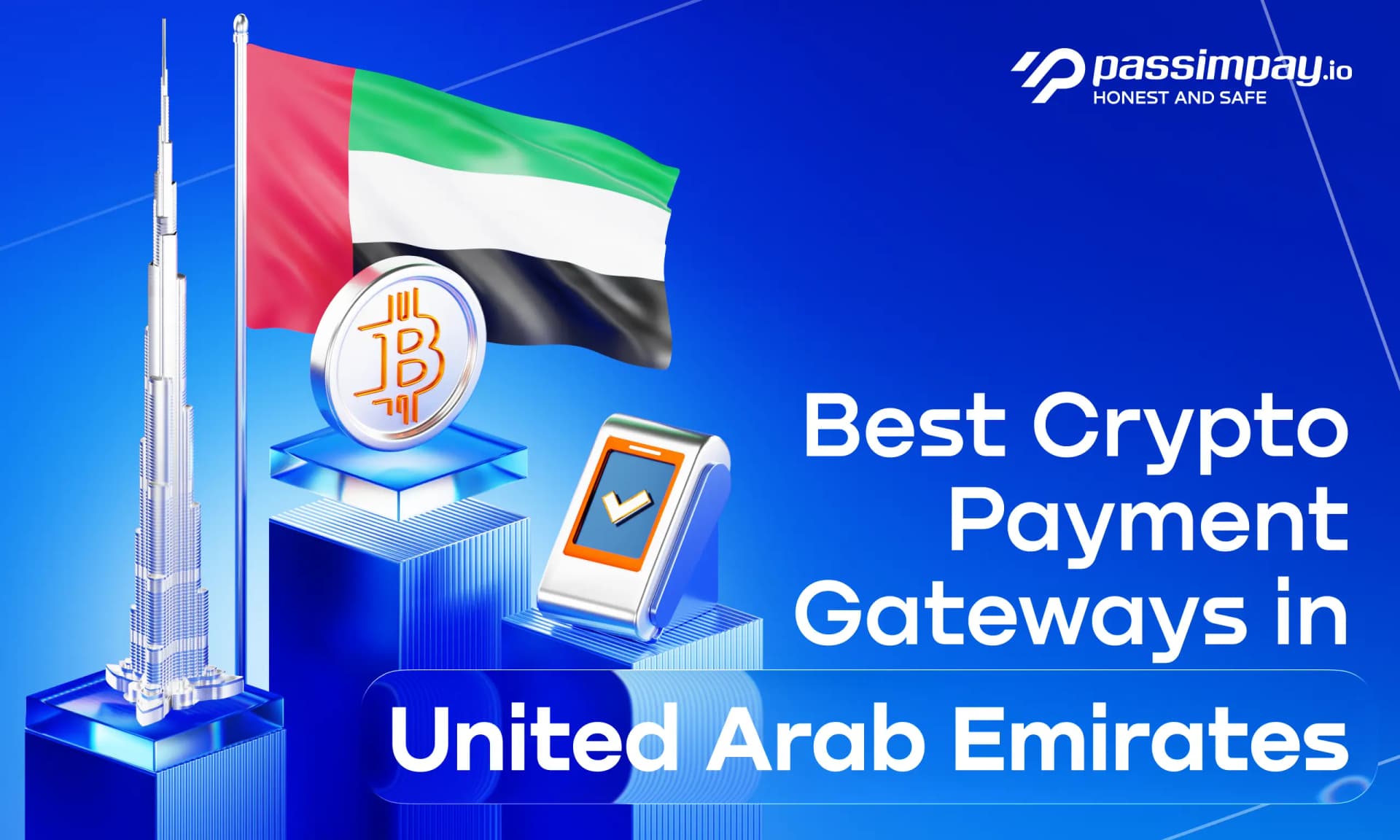
Best Crypto Payment Gateways for Businesses in the United Arab Emirates
25/08/2026
PassimPay could be one of the strongest crypto payment gateway options for businesses in the UAE that are eligible to use international crypto payment infrastructure. It supports 74 cryptocurrencies and 18+ blockchains, offers processing fees starting at 0.5%, and provides API integration and mass payout tools. Availability depends on the company's jurisdiction, payment model, and applicable regulatory requirements.
Why UAE Businesses Are Rapidly Adopting Crypto Payments
The UAE has built a developed virtual-asset ecosystem around Dubai and Abu Dhabi. It has regulated exchanges, custodians, Web3 companies and fintechs operating under dedicated frameworks.
Growing demand comes from SaaS companies, exporters, travel businesses, marketplaces, real-estate groups and luxury retailers that serve international customers or counterparties that already hold digital assets. Web3 companies also need infrastructure for cross-border payments, treasury operations and payouts.
For B2B companies, stablecoins can provide another settlement rail for international transactions where the structure is permitted. This does not mean every UAE merchant can freely accept cryptocurrency. The legal position depends on the entity, jurisdiction, asset, transaction and parties involved.
The State of Crypto Payments in the UAE in 2026
UAE crypto regulation is divided across several authorities.
VARA, the Virtual Assets Regulatory Authority, regulates virtual asset activities in and from Dubai, including mainland Dubai and its free zones, except the Dubai International Financial Centre (DIFC). Its framework covers activities including exchange, custody, broker-dealer services and virtual asset transfer and settlement. Firms carrying out regulated virtual asset activities in Dubai generally require the appropriate VARA authorization.
The DFSA regulates financial services in the DIFC. Updated Crypto Token rules took effect on January 12, 2026. Among the changes, authorized firms became directly responsible for assessing whether Crypto Tokens they use satisfy the DFSA's suitability criteria rather than relying on a prescribed list of recognized tokens.
ADGM's Financial Services Regulatory Authority (FSRA) regulates virtual asset activities within Abu Dhabi Global Market. Changes covering regulated activities involving fiat-referenced tokens took effect on January 1, 2026, as ADGM continued developing its dedicated framework for virtual assets and token-based financial services.
The Central Bank of the UAE (CBUAE) separately regulates Payment Token Services outside the UAE's Financial Free Zones. Its Payment Token Services Regulation covers issuance, conversion, custody and transfer of payment tokens and places specific restrictions on which virtual assets merchants may accept as payment.
AML controls, customer due diligence, sanctions screening, transaction monitoring and reporting therefore matter alongside the checkout technology. CBUAE supervisory material in 2026 has continued to emphasize transaction monitoring and suspicious transaction reporting for payment-token service providers.
Can Businesses in the UAE Accept Cryptocurrency Payments?
A UAE business should not assume that it can accept Bitcoin (BTC), Tether (USDT), USD Coin (USDC) or another virtual asset for ordinary sales simply because a payment gateway technically supports it.
Outside the Financial Free Zones, Article 2(7) of the CBUAE Payment Token Services Regulation restricts merchant acceptance of virtual assets. It permits a Dirham Payment Token issued by a licensed issuer for lawful payments, while a Foreign Payment Token may be used as payment only for the purchase of a virtual asset or virtual asset derivative.
The provision excludes Financial Free Zones, meaning DIFC and ADGM operate under their respective frameworks. The position can also vary according to the merchant activity and provider model.
UAE companies should therefore verify the proposed payment flow with the relevant provider, regulator and qualified local counsel before enabling crypto checkout. This article compares payment infrastructure and does not constitute legal advice.
Why UAE Companies Use Crypto Payment Gateways
Where a crypto payment flow is permitted, a gateway removes much of the blockchain infrastructure burden from the merchant.
Companies can use a gateway to generate payment addresses, detect incoming transactions, update order status, screen transactions, convert assets, automate payouts and reconcile payments. Stablecoins can also reduce exposure to the price volatility associated with assets such as Bitcoin or Ethereum.
Common reasons include international customers, 24/7 blockchain availability, faster cross-border transfers and payment automation. UAE business discussions also frequently focus on practical issues around compliant USDT acceptance, fiat off-ramping, banking relationships and maintaining adequate transaction records for accounting and compliance.
Fiat settlement can still involve banking hours, compliance checks and jurisdiction-specific restrictions, so crypto infrastructure does not eliminate the need for conventional financial operations.
What Makes a Great Crypto Payment Gateway in the UAE?
A UAE comparison should weight compliance and international operations more heavily than raw coin count.
A crypto payment gateway is infrastructure that generates payment requests, monitors blockchain transactions and reports or processes payment status and settlement for a merchant. A stablecoin is a cryptoasset designed to track another asset, commonly a fiat currency, with USDT and USDC among the most widely used examples.
| Criterion | Weight | What to Examine |
|---|---|---|
| International payment capabilities | 25% | Cross-border reach, settlement options, business eligibility |
| Compliance & Security | 20% | KYB/KYC, AML screening, provider status, security controls |
| Stablecoin support | 15% | USDT, USDC and supported networks |
| API & Automation | 15% | APIs, webhooks, payouts and automation |
| Processing Fees | 10% | Processing, conversion and network costs |
| Supported cryptocurrencies | 10% | Asset and blockchain coverage |
| Merchant tools | 5% | Plugins, Payment Links, invoices and reporting |
Decision Matrix: PassimPay provides the strongest all-round feature set in this comparison. Triple-A fits compliance-led enterprise flows; NOWPayments leads on asset coverage; CoinGate suits international merchants; CoinsPaid targets high-volume processing; BitPay suits established global merchants; Cryptomus and CoinPayments fit companies prioritizing conventional crypto merchant tools; and Confirmo is particularly relevant to European stablecoin-led operations.
Best Crypto Payment Gateways in the UAE
This ranking compares product capabilities. It does not mean that every provider is authorized to serve every UAE entity, jurisdiction or payment use case.
1. PassimPay — Best Overall
PassimPay is designed for businesses that need to combine crypto payment acceptance with automated operational workflows. Merchants can use Payment Links, Static Wallets, Mass Payouts, CMS integrations, and API-based payment flows within the same platform.
Pros: flexible merchant tools, support for international payment workflows, and automation for both incoming payments and payouts.
Consider: UAE eligibility and the exact permitted payment flow must be verified before integration.
Best for: international businesses, Web3 companies, and merchants with complex payment or payout workflows.
Not for: companies that specifically require a locally authorized UAE provider without additional regulatory review.
2. Triple-A — Best for Enterprise Compliance
Triple-A supports Bitcoin, Ethereum (ETH), USDC and USDT across major networks, with APIs for payments and payouts. Its documentation lists 47 local currencies for payment requests, including the UAE dirham.
Pros: compliance-led model, stablecoin focus, API and local-currency settlement infrastructure.
Consider: pricing is negotiated rather than publicly fixed.
Best for: enterprises prioritizing compliance infrastructure.
Not for: merchants seeking maximum cryptocurrency coverage.
3. NOWPayments — Best for Maximum Coin Support
NOWPayments supports more than 350 assets and provides API integration, custody options, mass payouts and merchant tools. Published pricing is 0.5% for payments without conversion and 1% where conversion is required, plus applicable network fees.
Pros: extensive asset support and flexible integrations.
Consider: a large asset list requires tighter treasury and compliance policies.
Best for: crypto-native businesses serving users with diverse wallets.
Not for: teams seeking a narrow stablecoin-focused stack.
4. CoinGate — Best for International Merchants
CoinGate provides API-based payments, payouts, refunds, conversion and e-commerce integrations. Its standard plan lists a 1% processing fee and support for more than 10 payment cryptocurrencies, with enterprise terms available separately.
Pros: established merchant tooling, settlement options and plugins.
Consider: payment-asset coverage is smaller than gateways focused on maximum coin support.
Best for: international merchants, particularly those with European operations.
Not for: businesses requiring hundreds of payment assets.
5. CoinsPaid — Best for High-Volume Businesses
CryptoProcessing by CoinsPaid supports more than 20 cryptocurrencies, 20+ blockchains, APIs, Mass Payouts, plugins and crypto-to-fiat workflows. CoinsPaid reported in 2026 that stablecoins represented more than 86% of its processed volume.
Pros: enterprise payment operations, payouts, plugins and reporting.
Consider: commercial pricing should be confirmed directly.
Best for: high-volume merchants and platforms.
Not for: companies requiring fully public pricing before vendor selection.
6. BitPay — Best for Global Merchants
BitPay supports major assets including Bitcoin, Ethereum, USDT, USDC and XRP, with daily settlement options. Merchant pricing is tiered: 2% + $0.25 below $500,000 in monthly volume, 1.5% + $0.25 from $500,000, and 1% + $0.25 from $1 million.
Pros: long operating history, fiat settlement and established merchant tools.
Consider: pricing is relatively high at lower processing volumes.
Best for: established global merchants.
Not for: smaller merchants primarily optimizing for processing cost.
7. Coinbase Business — Best for the Coinbase Ecosystem, but Not Currently for UAE Entities
Coinbase Commerce was retired on March 31, 2026 and replaced by Coinbase Business. Coinbase states that Coinbase Business is currently available to legal entities in the United States and Singapore, with additional regions planned.
Pros: payment links, checkouts, payouts and API automation.
Consider: current UAE entity eligibility is the decisive limitation.
Best for: eligible companies already using the Coinbase ecosystem.
Not for: UAE-incorporated companies while local onboarding remains unavailable.
8. Cryptomus — Best for SMEs
Cryptomus supports 100+ cryptocurrencies and provides invoices, Static Wallets, QR Codes, Mass Payouts, API access and CMS plugins including WooCommerce, Tilda, OpenCart, PrestaShop and WHMCS.
Pros: broad asset coverage and accessible merchant tools.
Consider: published pricing states 2% for new users, while negotiated rates can fall as low as 0.4%.
Best for: SMEs seeking multiple integration options.
Not for: companies that specifically require a UAE regulatory footprint.
9. CoinPayments — Best Legacy Platform
CoinPayments provides a REST API, webhooks, wallets, invoices and shopping-cart integrations. Its current platform lists 30+ cryptocurrencies for payments, with processing fees of 0.5% for coins and 1% for tokens.
Pros: mature merchant tooling and wallet functionality.
Consider: businesses should distinguish between its legacy products and current platform.
Best for: merchants already familiar with CoinPayments.
Not for: teams seeking a stablecoin-first enterprise stack.
10. Confirmo — Best for European Businesses
Confirmo is a stablecoin-focused platform offering checkout, invoicing, payouts, fiat conversion and API integration. Its European entity is authorized by the Central Bank of Ireland as a Crypto-Asset Service Provider under MiCA.
Pros: European regulatory positioning, stablecoin focus and payout infrastructure.
Consider: jurisdiction-specific availability and commercial terms need to be confirmed.
Best for: European businesses and cross-border stablecoin flows.
Not for: merchants whose priority is the largest possible coin list.
Comparison Table
| Gateway | Processing Fees | Supported Coins | Blockchains | API | CMS Plugins | Compliance | Settlement | Best For |
|---|---|---|---|---|---|---|---|---|
| PassimPay | Starting at 0.5% | 74 | 18+ | Yes | 12 | KYC/KYB, AML controls | Crypto/stablecoin; eligible fiat options | Best overall |
| Triple-A | Custom | BTC, ETH, USDC, USDT | Major networks | Yes | Integration-led | Compliance-led model | Stablecoin/local currency | Enterprise compliance |
| NOWPayments | 0.5%; 1% with conversion | 350+ | Multiple | Yes | Yes | Merchant verification/risk controls | Crypto/custody/fiat options | Coin coverage |
| CoinGate | 1% standard | 10+ | Multiple | Yes | Yes | KYC/KYB controls | Crypto and fiat options | International merchants |
| CoinsPaid | Custom | 20+ | 20+ | Yes | Yes | KYB, monitoring | Crypto/fiat options | High volume |
| BitPay | 1–2% + $0.25 | Major assets | Multiple | Yes | E-commerce tools | KYC/compliance program | Crypto/fiat | Global merchants |
| Coinbase Business | Account-based | USDC/USDT payments | Major EVM networks | Yes | Checkout integrations | Coinbase business controls | Stablecoin/bank off-ramp | Coinbase ecosystem |
| Cryptomus | 2% new users; as low as 0.4% negotiated | 100+ | Multiple | Yes | Yes | AML tools | Crypto/conversion | SMEs |
| CoinPayments | 0.5% coins; 1% tokens | 30+ for payments | Multiple | Yes | Yes | Account controls | Crypto | Legacy users |
| Confirmo | Contract/current fee schedule | 10+ currencies | Multiple | Yes | Limited | MiCA-authorized EU entity | Stablecoin/fiat/crypto | European businesses |
Why PassimPay Ranks #1
PassimPay ranks first because its capabilities cover several of the criteria used in this comparison rather than focusing on a single payment function. The platform combines merchant payment tools, payout infrastructure, multiple integration methods, and support for international crypto operations.
Its reported operating scale also supports this position. PassimPay has processed more than $4 billion in volume, works with 530+ active merchants, and processes around 750,000 transactions per month.
These figures indicate that the platform is built for businesses that need more than a basic crypto checkout. However, product capabilities do not by themselves establish whether PassimPay or a particular payment flow is permitted for a specific UAE entity.
Which UAE Businesses Benefit Most?
Crypto payment infrastructure is most relevant to companies with cross-border or digital-asset-native flows: Web3 companies, SaaS providers, fintechs, marketplaces, PSPs, exporters and logistics platforms.
Travel, real estate, luxury retail and e-commerce companies may also see customer demand for crypto payments, but these sectors must first determine whether the proposed payment method is permitted for their entity and jurisdiction.
A gateway therefore makes the most sense when crypto solves a specific operational requirement: serving digital-asset users, receiving international payments, automating blockchain-based deposits or managing payouts at scale.
Supported Coins, Networks and Integrations
PassimPay supports 74 cryptocurrencies and 18+ blockchains. Major available assets include Bitcoin (BTC), Ethereum (ETH), Tether (USDT), USD Coin (USDC), XRP (XRP), Solana (SOL), TRON (TRX), BNB (BNB), Litecoin (LTC), Bitcoin Cash (BCH), Dogecoin (DOGE), and Dai (DAI).
For businesses that prefer ready-made integrations, PassimPay provides 12 CMS plugins for Shopify, WooCommerce, Magento 2, OpenCart, PrestaShop, WHMCS, Drupal, Joomla, MODX, Shop-Script, Tilda, and Bitrix.
This gives merchants a choice between a ready-made CMS connection and a custom API integration depending on their technical requirements.
Security, Compliance and Reliability
A crypto payment gateway becomes part of a company's financial infrastructure, so reliability and compliance controls should be evaluated separately from asset coverage or pricing.
PassimPay applies KYC/KYB and AML controls and reports 99.99% uptime. Businesses should also review access management, withdrawal security, transaction monitoring, reporting procedures, and the legal entity providing the service.
For UAE companies, the provider's technical availability should not be treated as evidence of a VARA, DFSA, ADGM, or CBUAE authorization. Regulatory eligibility must be assessed for the specific entity and payment flow.
Processing Fees
PassimPay offers processing fees starting at 0.5%.
The processing rate should be considered together with other possible costs, including blockchain network fees, conversion charges, withdrawals, and fiat settlement. The lowest headline fee does not always produce the lowest total payment cost, particularly when a transaction involves conversion between assets or additional settlement steps.
API, Automation and Mass Payouts
PassimPay provides several tools for automating payment and payout workflows. Businesses can use API integration, QR Codes, Payment Links, Static Wallets, Mass Payouts, and payouts through the API.
Webhooks and transaction statuses can be used to automatically update orders, invoices, or customer balances after a payment changes status.
For high-volume integrations, businesses should test concurrency, failed transactions, retry logic, webhook handling, and reconciliation before launch. These operational details can be more important than the number of API endpoints alone.
How to Choose the Right Crypto Payment Gateway in the UAE
- Identify the company's exact UAE jurisdiction: mainland/free zone, DIFC or ADGM.
- Confirm whether the planned asset and payment use case are permitted.
- Verify the provider's regulatory status and onboarding eligibility.
- Check USDT and USDC support on the networks customers actually use.
- Compare total pricing rather than only the headline processing fee.
- Test API documentation, webhooks, plugins and payout automation.
- Review reporting, reconciliation and finance-team workflows.
- Check uptime, transaction capacity and incident procedures.
- Review KYB/KYC, AML screening and sanctions controls.
- Confirm settlement, banking off-ramp and support arrangements before launch.
FAQ
What is the best crypto payment gateway in the UAE?
PassimPay ranks first in this comparison because it performs strongly across international payments, merchant tools, automation, integrations, and operational scale. It is particularly relevant to businesses that need both incoming crypto payments and payout functionality. UAE companies must still confirm that their entity and intended payment model are eligible before integration.
Can businesses in Dubai accept cryptocurrency?
Dubai businesses cannot assume that all cryptocurrencies can be accepted for ordinary goods and services. Outside DIFC, CBUAE payment-token rules and VARA requirements can both be relevant. The permitted structure depends on the asset, transaction and provider. DIFC businesses fall under a separate DFSA framework.
Is crypto legal in the UAE?
The UAE regulates virtual assets rather than treating all crypto activity as generally prohibited or generally permitted. Different rules apply through the CBUAE, VARA, DFSA, ADGM FSRA and other relevant authorities. The legality of a specific transaction depends on the activity, asset, jurisdiction and parties involved.
Which crypto payment gateway is best for Dubai startups?
PassimPay can suit Dubai startups that need flexible integration methods without building their own blockchain payment infrastructure. Payment Links and CMS plugins can support relatively simple setups, while the API provides more control for custom products. The startup should confirm its regulatory eligibility and permitted payment model before launching crypto payments.
Which gateway supports USDT?
PassimPay, Triple-A, NOWPayments, BitPay, Cryptomus, CoinPayments and Confirmo support Tether (USDT) in at least some payment flows. Network support differs by provider. UAE merchants should also confirm whether their intended USDT payment use case is permitted under the rules applying to their entity.
Which gateway is best for Web3 companies?
PassimPay is particularly relevant to Web3 companies that need both payment acceptance and operational crypto tools such as Static Wallets, automated payouts, and API-based workflows. Triple-A may be more suitable where enterprise compliance and stablecoin settlement are the dominant requirements. Eligibility should be verified separately for the company's UAE jurisdiction.
Does PassimPay work in the UAE?
PassimPay provides international crypto payment infrastructure, but product availability does not by itself establish regulatory eligibility for a UAE company. A business should confirm onboarding with PassimPay and verify the intended payment flow under the rules applying to its UAE jurisdiction before going live.
Which crypto payment gateway has the lowest fees?
Headline pricing varies by transaction type. PassimPay offers processing fees starting at 0.5%; NOWPayments publishes 0.5% for payments without conversion; CoinPayments lists 0.5% for coins; other providers use tiered or negotiated pricing. Network, conversion, withdrawal and settlement fees should be compared separately.
Which crypto payment gateway is best for SaaS?
PassimPay fits SaaS companies that need API-driven billing flows, Payment Links, stablecoin conversion and international payment infrastructure. Confirmo also provides stablecoin-oriented payment tooling, while NOWPayments supports broad asset coverage. UAE SaaS companies should first confirm that their customer payment model is permitted.
Can UAE companies accept stablecoins?
Stablecoin acceptance depends on jurisdiction and token classification. Outside Financial Free Zones, the CBUAE Payment Token Services Regulation restricts which virtual assets merchants may accept for goods and services. DIFC and ADGM operate under separate Financial Free Zone frameworks. Companies should verify the specific stablecoin and payment flow.
Which gateway supports Shopify?
PassimPay lists Shopify among its 12 CMS integrations. Businesses using Shopify can also compare gateways providing hosted checkout or API-based integration. The technical availability of a Shopify plugin does not replace regulatory review for a UAE merchant, and provider onboarding eligibility should be confirmed separately.
What should businesses consider before choosing a crypto gateway?
Start with regulatory eligibility, then compare international reach, stablecoin and network support, KYB/KYC and AML controls, API quality, plugins, settlement options, total fees, reporting, uptime and support. The right gateway should fit both the company's operating model and its permitted payment structure.
Final Thoughts
For UAE companies, choosing a crypto payment gateway in 2026 is primarily a question of regulatory fit and operational fit. PassimPay ranks first in this comparison on product breadth, combining 74 cryptocurrencies, 18+ blockchains, processing fees starting at 0.5%, API integration, 12 CMS plugins, 99.99% reported uptime and multiple merchant tools.
Before integration, a UAE business should confirm that its intended asset, payment flow, entity and provider structure are permitted in its jurisdiction.
Contact PassimPay to confirm business eligibility, integration requirements and commercial terms for your payment flow.
 Contact us →
Do you like this article? Share it with your friends.


More