Best BTCPay Server Alternatives in 2026 For Accepting Crypto Payments
16/07/2026
The best BTCPay Server alternative for businesses that want crypto payment infrastructure without running their own server could be PassimPay. It supports 74+ cryptocurrencies, charges from 0.5%, offers EUR and USD settlement, and has official licenses to work as a money services business. BTCPay Server remains free, open-source, self-hosted, and non-custodial, but it requires server maintenance and is primarily designed around Bitcoin payments.
Introduction
BTCPay Server is a free, open-source, self-hosted Bitcoin payment processor. It lets merchants accept Bitcoin directly without a middleman. There are no processing fees, no mandatory identity verification, and clients get full control over private keys. For Bitcoin-native projects with technical resources, that model is advantageous.
Yet, the same model can become a limitation for ordinary businesses. A merchant has to deploy and maintain its own server, manage updates, backups, wallet connections, security settings, and operational troubleshooting. The official Docker setup, for example, installs and configures Docker, Docker Compose, server startup behavior, environment variables, and related utilities.
BTCPay Server is also primarily Bitcoin-focused. It supports Lightning Network and opt-in altcoin integrations. Still, the project documentation makes clear that alternative coin support depends on the relevant coin communities. Businesses that need USDT, USDC, automatic conversion, or EUR and USD settlement often need a managed crypto payment gateway instead.
This article compares the best BTCPay Server alternatives in 2026 for merchants that want to accept crypto payments without taking on the full technical and operational load of a self-hosted stack.
How We Ranked the Best BTCPay Server Alternatives
We assessed each BTCPay Server alternative using seven criteria that affect business adoption:
- Security and compliance: regulatory status, merchant verification, transaction monitoring, account controls, and safeguards around funds.
- Fees and pricing transparency: processing fees, fixed charges, network fees, conversion costs, and the difference between software cost and total operating cost.
- Supported assets: the cryptocurrencies, stablecoins, and blockchain networks available for merchant payments.
- Settlement options: whether merchants can receive crypto, stablecoins, EUR, USD, GBP, or other fiat currencies.
- Setup and maintenance effort: whether the merchant must operate a server, manage updates, maintain backups, and handle incidents internally.
- Integrations: programming interfaces, ecommerce modules, invoices, payment links, recurring payments, and checkout tools.
- Merchant support: documentation, technical assistance, account management, payment recovery, and support for larger transaction volumes.
BTCPay Server received credit for its zero processing fee, self-custody, and open-source design. However, this ranking gives more weight to managed operations, fiat settlement, multi-coin support, and support availability because the target reader is a business, not a technical Bitcoin enthusiast.
BTCPay Server Alternatives Compared
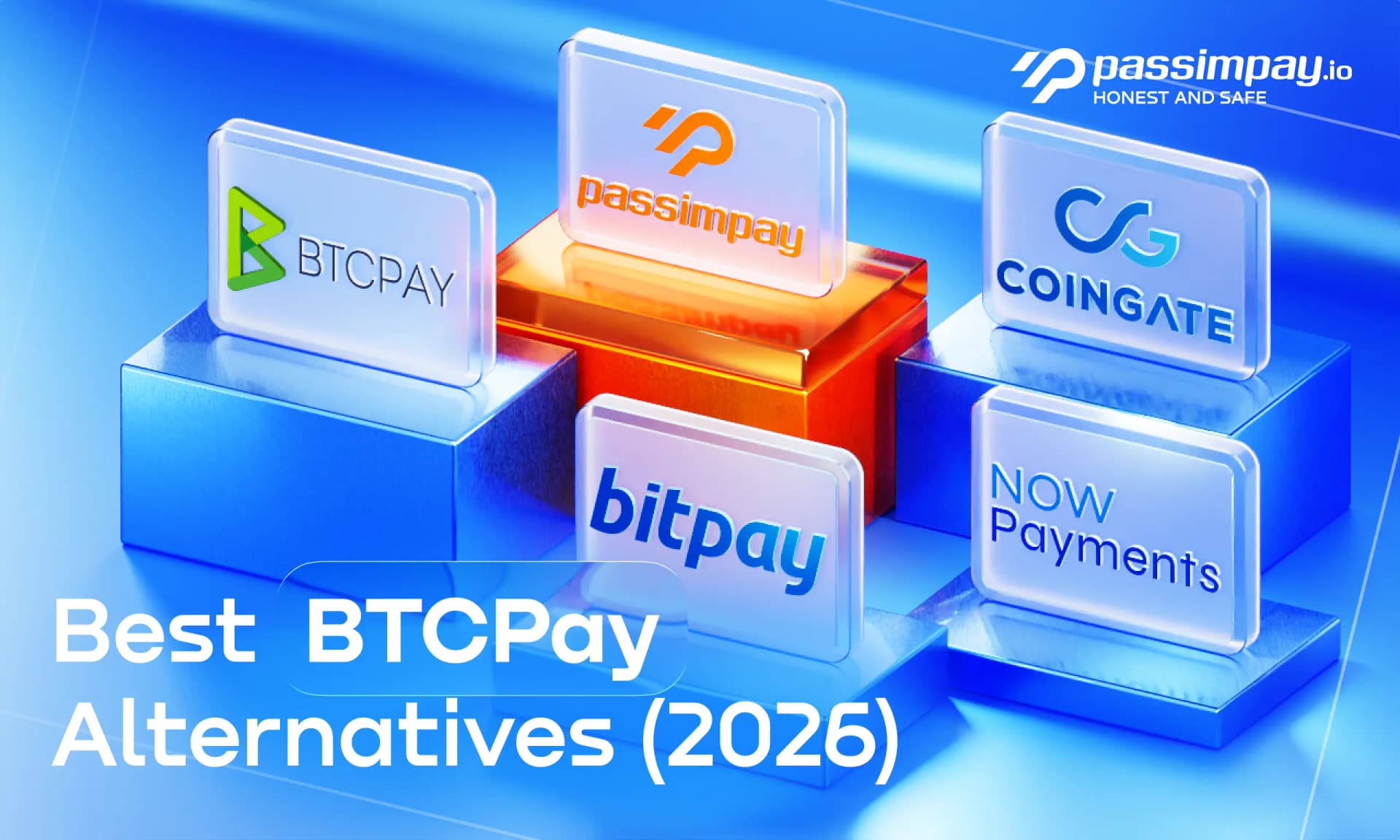
| Gateway | Fees | Coins | Setup | Best for |
|---|---|---|---|---|
| PassimPay | Starting at 0.5% | 74+ cryptocurrencies | Managed, no server needed | Best overall: managed, multi-coin, fiat settlement, and no technical maintenance |
| BTCPay Server | 0% processing fee, excluding network and hosting costs | Bitcoin-focused; opt-in altcoins via integrations | Requires own server and maintenance | Technical merchants that want full sovereignty, especially for Bitcoin payments |
| BitPay | 2% + $0.25 below $500,000 monthly; 1.5% + $0.25 from $500,000; 1% + $0.25 from $1 million | 100+ cryptocurrencies | Managed | US and high-volume merchants needing daily fiat settlement |
| CoinGate | 1% on the standard plan | 10+ cryptocurrencies | Managed | EU merchants needing regulated crypto-to-fiat settlement |
| NOWPayments | 0.5% without conversion; 1% with conversion | 350+ cryptocurrencies | Managed | Merchants needing maximum altcoin variety |
The figures above use current public information rather than older comparison data. BitPay now publishes volume-based pricing from 2% + $0.25 down to 1% + $0.25, CoinGate’s standard merchant plan lists 10+ accepted cryptocurrencies and a 1% processing fee, and NOWPayments publishes 0.5% for payments without exchange and 1% for payments with conversion.
1. PassimPay — Best Overall BTCPay Server Alternative
BTCPay Server is strongest when a merchant wants to own the full payment stack. PassimPay is stronger when a business wants crypto payment acceptance without running the infrastructure itself. The platform supports 74+ cryptocurrencies, charges from 0.5%, and offers automatic conversion and settlement options in EUR and USD.
This makes PassimPay a practical alternative for companies that like the low-cost logic of BTCPay Server but cannot justify operating their own server, monitoring nodes, managing backups, or solving payment incidents internally. Instead of maintaining a self-hosted checkout, merchants can connect through a programming interface, ecommerce modules, invoices, payment links, QR codes, or permanent wallet addresses.
PassimPay reports more than $4 billion in processed volume, 750k transactions per month, 99.99% service availability, and more than 530 merchants.
Advantages
- No server maintenance: merchants do not need to deploy a virtual private server, configure Docker, manage updates, or maintain backups.
- Broader ready-to-use asset support: PassimPay supports 74+ cryptocurrencies without requiring the merchant to rely on community-maintained altcoin integrations.
- Stablecoin and fiat settlement: incoming crypto can be converted into stablecoins, while eligible merchants can arrange settlement in EUR or USD.
- Lower technical burden: finance, ecommerce, and operations teams can manage payment acceptance without maintaining a dedicated Bitcoin server stack.
- Several integration routes: businesses can use a programming interface, ecommerce modules, invoices, payment links, QR codes, or permanent wallet addresses.
- Published operating record: processed volume, monthly transaction count, service availability, merchant count, and registration information are available for vendor review.
- Business verification: PassimPay uses identity and business verification, which can be useful for companies that need a documented payment provider for internal compliance review.
Drawbacks
- PassimPay is not free. Its processing fees start at 0.5%, while BTCPay Server has no percentage processing fee.
- Merchants do not control every part of the payment stack as they would with a self-hosted BTCPay Server deployment.
- Funds are handled through an account managed by the provider before conversion or withdrawal, so PassimPay is not a direct substitute for full self-custody.
- Identity and business verification are mandatory, unlike the no-verification model of BTCPay Server.
- Companies that specifically want a Bitcoin-only, self-hosted, non-custodial setup may still prefer BTCPay Server.
PassimPay is best suited to online stores, digital services, gaming platforms, marketplaces, and international merchants that need crypto payments as a business function, not as a technical self-hosting project.
2. BTCPay Server — Best for Technical Bitcoin Merchants
BTCPay Server remains one of the strongest options for merchants that want full control over Bitcoin payments. It is free, open-source, self-hosted, non-custodial, and designed to let funds arrive directly in the merchant’s connected wallet. It also supports Lightning Network and does not impose a platform processing fee.
The trade-off is operational responsibility. A merchant using BTCPay Server has to deploy, secure, update, and troubleshoot the server or pay someone to do that work. Hosting, technical labor, backups, monitoring, and incident response are not included in the “0% fee” claim, even though they are real business costs.
Advantages
- No processing fee: BTCPay Server does not charge a percentage fee for payment processing, apart from blockchain network fees and the merchant’s own infrastructure costs.
- Full self-custody: funds arrive directly to a wallet controlled by the merchant.
- No middleman: the merchant does not rely on a payment provider to receive or forward funds.
- Open-source software: the code can be reviewed, customized, and self-hosted.
- Strong Bitcoin focus: Bitcoin and Lightning Network support make it highly relevant for Bitcoin-native merchants.
- Privacy and autonomy: there is no mandatory identity verification imposed by the software itself.
- Extensible setup: opt-in integrations can add extra functionality, including some alternative coin support.
Drawbacks
- Server maintenance is required: the merchant must run or outsource hosting, updates, backups, monitoring, and security.
- Technical incidents are internal problems: there is no managed provider support team responsible for resolving business-impacting payment issues.
- Stablecoin support is not a standard managed feature: USDT, USDC, and other assets may require additional integrations or external tools.
- No built-in fiat settlement: merchants that want EUR or USD payouts need to convert crypto elsewhere, often through an exchange or separate service.
- Altcoin support depends on third parties: BTCPay Server documentation states that alternative coin integrations depend on the relevant coin community and are not added or maintained on request by the core project.
- Harder for non-technical teams: finance and ecommerce teams may need developer or infrastructure support for setup and ongoing operations.
BTCPay Server is best for technical Bitcoin merchants, privacy-focused projects, Bitcoin communities, and businesses that value self-custody more than managed settlement, broad coin support, or support availability.
3. BitPay — Best for US Enterprise Merchants
BitPay is a managed crypto payment processor for businesses that want to accept digital assets without operating a self-hosted server. Unlike BTCPay Server, it handles processing and settlement as a provider-managed service. BitPay supports 100+ cryptocurrencies and offers settlement in fiat currencies such as USD, EUR, and GBP, as well as selected crypto assets.
Its pricing is volume-based. Merchants processing less than $500,000 per month pay 2% plus $0.25 per transaction. The rate falls to 1.5% plus $0.25 from $500,000 and to 1% plus $0.25 at monthly volumes of $1 million or more.
Advantages
- Managed payment processing: merchants do not need to run their own crypto payment server.
- Daily settlement: businesses can receive regular fiat settlement directly to a bank account.
- Broad asset support: BitPay supports more than 100 cryptocurrencies.
- Fiat and crypto settlement options: merchants can receive proceeds in fiat, crypto, or a selected combination.
- Enterprise compliance infrastructure: BitPay publishes licensing and compliance information and is licensed by the New York State Department of Financial Services for virtual currency business activity.
- Online and in-person payment tools: hosted checkout, invoices, modules, programming interfaces, email billing, and retail payment tools are available.
Drawbacks
- BitPay is more expensive than BTCPay Server’s 0% processing fee and PassimPay’s 0.5% starting fee at lower monthly volumes.
- The fixed $0.25 charge can increase the effective cost of small transactions.
- Payments remain under BitPay’s management until settlement.
- Full business verification is required.
- Higher fees may apply to businesses classified as high risk.
- The service is better suited to established enterprises than small technical projects seeking maximum autonomy.
BitPay is best for US enterprises and high-volume international merchants that need managed settlement, bank payouts, and formal compliance processes more than self-hosted control.
4. CoinGate — Best for EU Merchants
CoinGate is a managed European crypto payment gateway for businesses that want regulated crypto payment processing without running their own server. Its standard plan charges 1% per payment with no monthly fee and supports 10+ cryptocurrencies for merchant payments. CoinGate also states that it operates under the EU Markets in Crypto-Assets framework.
Compared with BTCPay Server, CoinGate is less autonomous but easier for non-technical businesses to operate. Merchants can accept crypto, convert incoming payments, and settle into EUR, USD, GBP, crypto, or stablecoins depending on account setup and availability.
Advantages
- Managed setup: businesses do not need to deploy or maintain their own payment server.
- EU regulatory position: CoinGate gives European merchants a clearer basis for vendor and compliance review.
- Simple standard pricing: the published processing fee is 1%, with no monthly charge on the standard plan.
- Fiat and stablecoin settlement: incoming crypto can be converted into EUR, USD, GBP, or supported stablecoins.
- Several integration methods: modules, programming interfaces, invoices, payment channels, and account-based tools are available.
- Published service fees: processing, payout, conversion, and withdrawal charges are listed publicly.
Drawbacks
- CoinGate’s 1% standard fee is higher than PassimPay’s starting fee and much higher than BTCPay Server’s zero processing fee.
- Support for 10+ payment assets is narrower than PassimPay, BitPay, and NOWPayments.
- Merchant balances remain under provider management until withdrawal or settlement.
- Full company verification and compliance review are required.
- The product is most relevant to European merchants; companies in other regions should confirm access, settlement options, and contract terms.
CoinGate is best for EU ecommerce companies, marketplaces, and subscription services that need managed crypto payments, regulatory clarity, and fiat settlement.
5. NOWPayments — Best for Maximum Altcoin Coverage
NOWPayments is the broadest managed option in this comparison by asset count. It supports more than 350 cryptocurrencies and provides programming interfaces, ecommerce modules, invoices, payment links, buttons, recurring payments, point-of-sale tools, mass payouts, and branded payment pages.
The service fee is 0.5% when the merchant receives the same asset used by the customer. Payments involving automatic conversion generally cost 1%, and blockchain network fees apply separately. Compared with BTCPay Server, NOWPayments is less self-sovereign but much easier for businesses that want broad coin coverage without maintaining their own infrastructure.
Advantages
- Maximum asset variety: more than 350 cryptocurrencies are available for payment acceptance.
- Competitive fee without conversion: the service fee is 0.5% when no exchange is required.
- Automatic conversion: merchants can accept multiple assets while receiving a preferred cryptocurrency or stablecoin.
- Managed infrastructure: businesses do not need to run their own crypto payment server.
- Wide integration range: programming interfaces, ecommerce modules, invoices, payment links, buttons, recurring payments, retail tools, and mass payouts are available.
- Checkout customization: selected tools allow merchants to create a branded payment experience.
Drawbacks
- The 0.5% rate does not apply to all flows; payments with conversion generally cost 1%.
- Network fees remain separate and can materially affect the final cost.
- Fiat conversion and payouts may depend on third-party partners and jurisdictional availability.
- Accepting hundreds of assets can create additional accounting, liquidity, and treasury work.
- Merchants need to review custody and payout settings carefully.
- Its regulatory positioning is less direct for EU merchants than CoinGate’s MiCA-focused model.
NOWPayments is best for crypto-native companies, online communities, gaming platforms, and merchants that need the widest possible altcoin coverage without maintaining BTCPay Server themselves.
FAQ
What is the best alternative to BTCPay Server?
PassimPay could be the best BTCPay Server alternative for businesses that want managed crypto payment infrastructure. It supports 74+ cryptocurrencies, starts at 0.5%, offers EUR and USD settlement, and does not require the merchant to run a server. BTCPay Server remains better for technical merchants that want full self-custody and Bitcoin-focused payments.
Is BTCPay Server free to use?
BTCPay Server is free and open-source, and it does not charge a percentage processing fee. Merchants still need to pay for blockchain network fees and may also incur hosting, server maintenance, backup, security, and technical labor costs. “Free” describes the software fee, not the full operating cost.
Why do businesses look for a BTCPay Server alternative?
Businesses often look for a BTCPay Server alternative when they do not want to run their own server, manage updates, maintain backups, or troubleshoot payment infrastructure internally. They may also need stablecoins, broad altcoin support, managed support, automatic conversion, and EUR or USD settlement that are not part of BTCPay Server’s core Bitcoin-focused setup.
Does BTCPay Server support stablecoins like USDT or USDC?
BTCPay Server is primarily Bitcoin-focused and supports opt-in altcoin integrations. The official documentation says alternative coin support depends on the relevant coin communities and is not added or maintained on request by BTCPay Server developers. Businesses that need standard managed support for USDT, USDC, and fiat settlement should verify available integrations or choose a managed gateway.
Is PassimPay a good alternative to BTCPay Server for non-technical merchants?
PassimPay is a go-to BTCPay Server alternative for non-technical merchants because it removes the need to operate a self-hosted payment server. It supports 74+ cryptocurrencies, provides managed payment tools, and allows eligible merchants to receive settlement in EUR or USD. The trade-off is that PassimPay charges start from 0.5% and requires identity and business verification.
Final Words
BTCPay Server is still one of the strongest choices for technical Bitcoin merchants that want self-custody, no middleman, open-source software, and zero percentage processing fees. It works best when the business has the technical capacity to run and maintain its own payment infrastructure.
PassimPay is the stronger alternative for businesses that want crypto payment acceptance without server maintenance. It offers a managed setup, 74+ cryptocurrencies, automatic conversion, EUR and USD settlement, and published operating figures.
The right choice depends on what the merchant values more. If full sovereignty and Bitcoin-native infrastructure matter most, BTCPay Server remains difficult to replace. If the priority is multi-coin support, fiat settlement, lower operational effort, and business support, PassimPay is the more practical option.
 Contact us →
Do you like this article? Share it with your friends.


More